Love Muscle
Grape Zing Nesium
Grape Zing Nesium
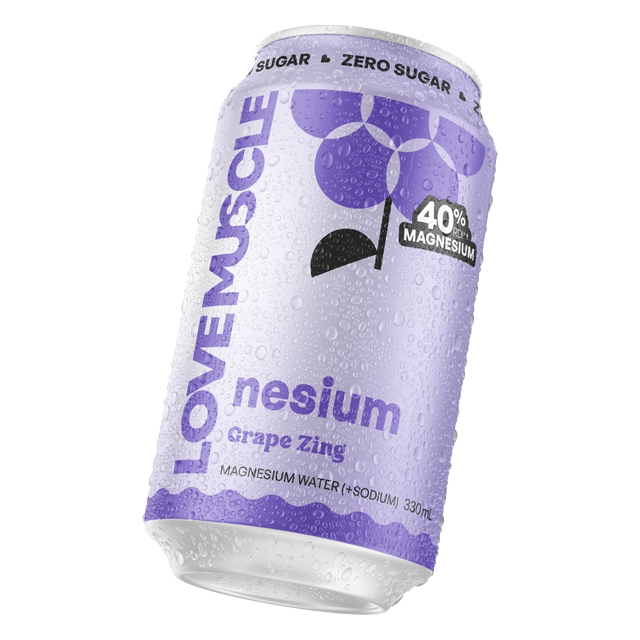
Meet your daily hydration with a magnesium boost. Each can of Nesium Grape Zing delivers 40% of your recommended daily magnesium intake in a crisp, lightly sparkling sip — without the salty aftertaste.
Sparkling water with magnesium + sodium to support normal muscle function, electrolyte balance and everyday energy levels. Vegan-friendly, with natural flavours and colours. Easy, on-the-go format. No powders or tablets, no mixing, no fuss.
Couldn't load pickup availability
- 40% RDI of Magnesium
 Zero sugar
- Refreshing
Ingredients
Ingredients
Nutritional Information
Nutritional Information
How to Enjoy
How to Enjoy
Sip anytime you want hydration with a meaningful magnesium top-up. Best served chilled.
Sustainability
Sustainability
- Aluminium cans are infinitely recyclable, helping reduce waste and environmental impact
- Long shelf life with minimal refrigeration, supporting lower food waste across the supply chain
Good to know
Good to know
Magnesium contributes to normal muscle function, electrolyte balance and reduction of tiredness and fatigue. This product is a food, not a medicine.


Sound Familiar?
Your body has been trying to tell you.
Magnesium deficiency rarely announces itself. It shows up as a collection of everyday feelings you've probably just been pushing through.
You're tired but can't sleep well
Magnesium regulates melatonin and supports the nervous system's ability to switch into rest mode. Low levels disrupt sleep quality even when you're exhausted.
Muscle cramps or twitching
Magnesium is essential for muscle relaxation. Without enough, muscles contract without fully releasing — causing cramps, spasms, and that annoying eye twitch.
Brain fog and low focus
Electrolyte balance directly affects nerve signalling. When it's off, mental clarity suffers — concentration dips, decisions feel harder, and you lose sharpness.
Afternoon energy crashes
Magnesium is involved in over 300 enzymatic reactions including ATP production — the process that powers every cell in your body. Low magnesium means low energy output.
Regular headaches
Low electrolyte levels — especially sodium and magnesium — are a well-documented trigger for tension headaches and migraines. Often the first symptom people notice.
Feeling stressed or on edge
Magnesium plays a key role in regulating the body's stress response through the HPA axis. Chronic stress depletes magnesium — and low magnesium amplifies stress. A cycle worth breaking.
What Changes
What proper electrolyte balance actually feels like.
When your body has the electrolytes it needs, the difference isn't dramatic — it's the absence of the friction that was slowing you down.
Better Sleep Quality
Magnesium supports the regulation of melatonin and GABA — the neurotransmitter that quiets the nervous system for sleep.
Via GABA receptor activation
Steadier Energy
Magnesium is required for ATP synthesis — the process your cells use to produce energy. Without it, your mitochondria run at reduced capacity.
Via ATP energy metabolism
Less Muscle Tension
Calcium causes muscle contraction; magnesium enables relaxation. The balance between them determines whether your muscles recover or stay tight.
Via calcium-magnesium antagonism
Actual Cellular Hydration
Sodium in trisodium citrate drives water into cells rather than straight through — the difference between being hydrated and just drinking a lot of water.
Via sodium-potassium pump
Sharper Focus
Electrolyte balance directly supports nerve signal transmission. When levels are optimal, neurotransmitter function improves — and mental clarity follows.
Via nerve signal conductance
Reduced Stress Response
Magnesium regulates the HPA axis — the system that controls cortisol. Adequate levels help moderate your physiological stress response over time.
Via HPA axis regulation
Grape Zing Nesium Reviews
- Rated 5 out of 5 stars3 months agoGame changer for recovery and sleep
I have been buying these for months and they help so much with muscle soreness and recovery. I've started drinking them before bed and they help me sleep too! Maybe my favourite flavour out of any of the drinks!!
KRKennedy R.Verified Reviewer - Rated 4 out of 5 stars8 months agoLove this stuff!
The perfect drink post workout and sauna. I like that it's not sweet and has a hint of saltiness. It's not cheap to drink all the time so when I saw it for 50% off I had to jump at the opportunity to stock up. Refreshing and delicious, I would definitely recommend trying.
GDGlenis D.Verified Buyer - Rated 5 out of 5 stars1 year agoDeliciousness in a can
The flavour is Devine. My new go-to alongside Pineapple sparkling protein water.
LLLillian L.Verified Buyer - Rated 5 out of 5 stars11 hours agoLove, love, love!
This is one of my favourite post workout treats. Hard to find in stores but I love the tangy and salty taste of this. You get the fizzy, treat like drink that tastes nice and is actually good for you. I would 100% recommend.
GDGlenis D.Verified Reviewer